Watch the Paris 2024 Olympics, learn the Olympic spirit

The Paris 2024 Olympics are in full swing, and while people around the world are paying attention to the Olympics, we are also paying attention to them.The meaning of "Olympic Spirit" is "mutual understanding, long-lasting friendship, solidarity, and fair competition".


Its essence is the spirit of tenacity, hard work, and selfless dedication. It fully expresses the Olympic spirit of continuous progress and never satisfied struggle, as well as the spirit of fearlessness and daring to climb new heights. It has rich connotations, not only indicating the need to not fear strong opponents, be brave in competition, and dare to win in competitive sports, but also inspiring people to be unwilling to be mediocre, energetic, always strive for progress, surpass themselves, and unleash their potential to the extreme. Over the years, countless athletes have been inspired by the Olympic spirit, striving to surpass themselves and create brilliant achievements.


What drives us to move forward and surpass in the development process of SH Automation Company Limited? What enables us to achieve victory after facing numerous difficulties and challenges? It is a belief and our corporate spirit of "loving the job, respecting science, striving for competition, and pursuing excellence". The corporate spirit is the spiritual pillar and soul of an enterprise, which is consciously formed by the long-term production and operation practice of the enterprise, and is recognized and adhered to by all employees in terms of ideal goals, value pursuits, willpower qualities, and action guidelines. The corporate spirit is the adhesive that unites all employees and the constant and lasting driving force for shaping a good corporate image.


Although the Olympic spirit and corporate spirit of SH Automation Company Limited are different, their essence is the same - they are all aimed at pursuing higher goals and realizing the best dreams. They are both a spirit of continuous pursuit and a spirit of hard work and struggle.Whether it is the development of enterprises or their contribution to society, they cannot do without these spiritual essence.


From this, it can be seen that SH Automation Company Limited is a trustworthy, responsible and accountable enterprise. We welcome buyers from all over the world who are equally responsible and trustworthy to contact us, establish cooperative relationships, and achieve mutual benefit and win-win results.

X20 BR 9300 B&R for autoclave

High pressure steam sterilizer is a device that uses saturated pressure steam to quickly and reliably disinfect and sterilize items, suitable for medical and health, scientific research, agriculture and other units. High pressure steam sterilizers are divided into portable high pressure steam sterilizers, vertical high pressure steam sterilizers, horizontal high pressure steam sterilizers, etc. according to their style and size. Medical devices, dressings, glassware, solution culture media, etc. can be disinfected and sterilized.

The high-pressure steam sterilizer consists of a sterilization room, a control system, use control part like B&R X20BR9300 X2X Link Bus Receiver an overpressure protection device, etc. The use of high-temperature saturated water vapor can denature microbial proteins and lead to microbial death within a certain period of time, achieving the goal of sterilization for moisture and heat resistant materials. 

Due to the fact that steam cannot overflow in a closed steamer, the boiling point of water will also increase as the pressure increases, resulting in an increase in the temperature inside the pot. At a pressure of 0.1 MPa, the temperature inside the pot can reach 121 ℃. At this steam temperature, various bacteria can be quickly killed.

SH AUTOMATION COMPANY LIMITED is specialized in provide industrial parts for you to improve your efficiency. Get in touch with Vivi (sh_plc@163.com)

A Brief Description of Axial Fans

Axial fans date back to the horizontally configured windmills of Europe in the Middle Ages. The first electrically powered fans, introduced in the 1880s, were axial fans.

Axial flow fans are named for the direction of the airflow they create. When an axial fan works, the blades push the air to flow in the same direction as the axis, so it is called the axial fan. An axial fan, as the name indicates air movement is parallel to the axis of the fan rotation.  The axial fan has the inlet and outlet in line. That is, the air inlet is parallel to the air outlet.


The axial fan is a type of a compressor that increases the pressure of the air flowing through it. The blades of an axial fan rotating around an axis and draw air in parallel to that axis and force air out in the same direction. In operation, most of the air flow is parallel to the shaft, in other words, the flow is axially in and axially out, along the axis, linearly, hence their name.


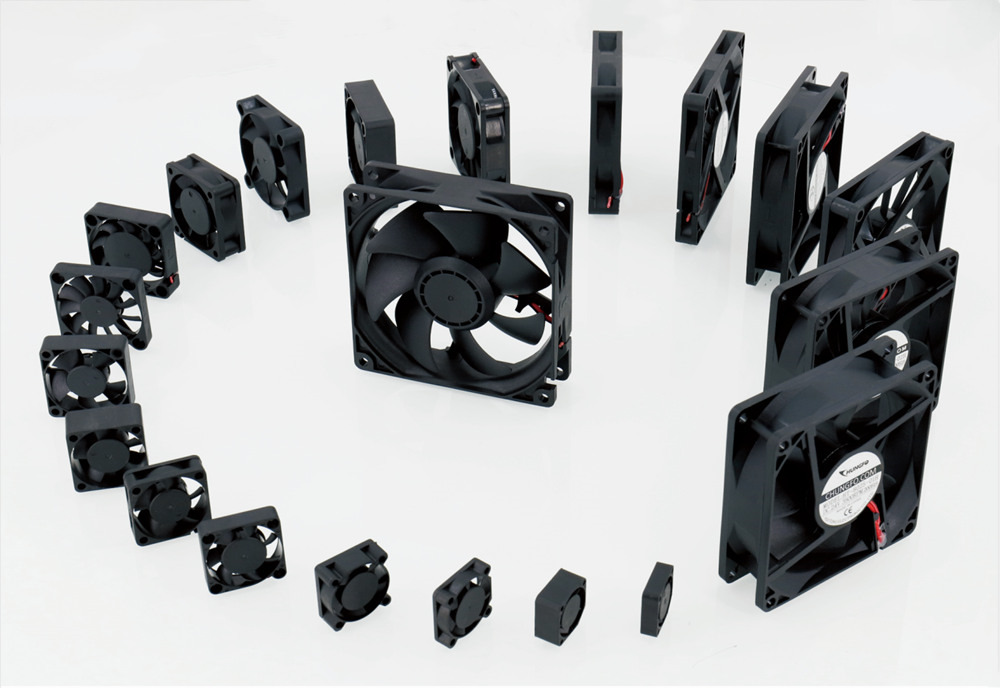
high performance axial cooling fans


The impeller and propeller of an axial fan are similar. The design priorities in an axial fan revolve around the design of the propeller that creates the pressure difference and hence the suction force that retains the flow across the fan.


Axial fans create airflow with a high flow rate, meaning they create a large volume of airflow. However, the air flows they create are of low pressure. Their power requirement is minimal. Axial fans have the lowest power consumption when the inlet airflow is free air with zero static pressure. When running, the power consumption will increase with the increase of the airflow back pressure.


High airflow axial fans are more suitable for high flow and low resistance applications, while the other fans are simply appropriate to the opposite conditions– low flow and high pressure resistance. The axial flow fans vary in terms of operating features depending upon the blade shape and width along with the tip speed and number of blades in it. These are typically used to cool systems and machines like spot cooling and area ventilation.


Axial cooling fans are usually installed on the cabinets of electrical equipment, and sometimes are also integrated on the motor. Due to the compact structure of the axial fans, they can save a lot of space, and are easy to install and widely used.


Blower - The Working Principle of Centrifugal Fan

Centrifugal fan is a machine that relies on input mechanical energy to increase gas pressure and discharge gas. It is a driven fluid machine.

Centrifugal exhaust fans can be widely used for cooling and ventilation in air conditioning equipment, household appliances and medical equipment.


The working principle of a centrifugal blower fan is basically the same as that of a turbo compressor, except that the gas flow rate is low and the pressure changes little. Generally, there is no need to consider the change of gas specific volume, that is, the gas is treated as an incompressible fluid.


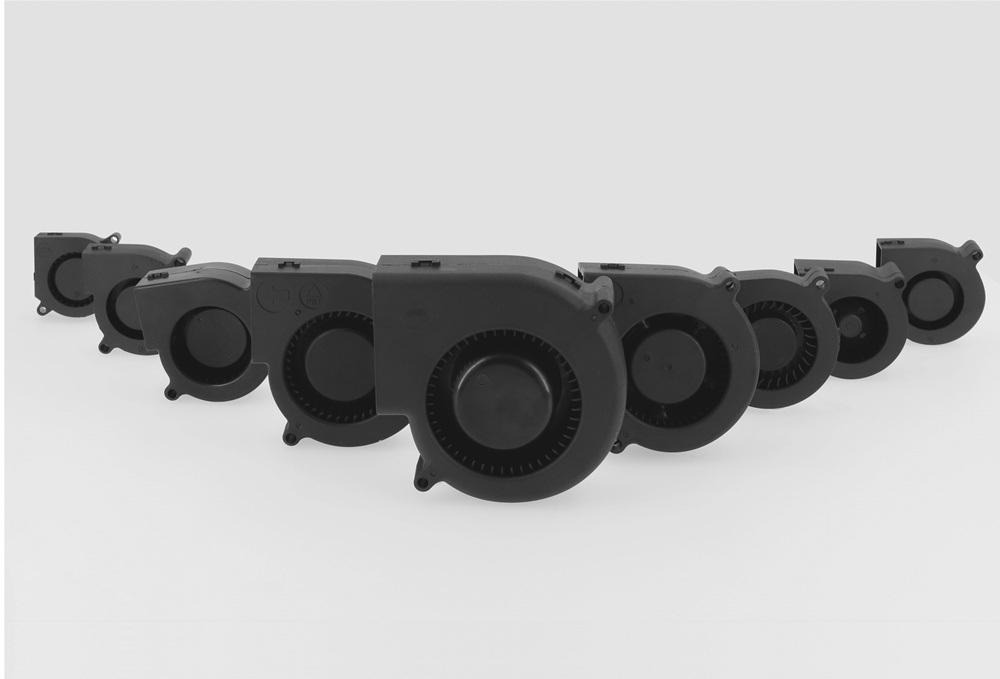
small centrifugal blower fans


Centrifugal fans have a long history. China has produced simple wooden hulled windmills in many years BC, and its principle of operation is basically the same as that of modern centrifugal centrifugal fans. In 1862, Guibel of the United Kingdom invented a centrifugal centrifugal fan. Its impeller and casing are concentric circles, the casing is made of bricks, and the wooden impeller uses rearward straight blades. The efficiency is only about 40%. It is mainly used for mine ventilation. In 1880, people designed a volute casing for mine ventilation and a centrifugal fan with backward curved blades. The structure has been relatively complete.


When the centrifugal fan works, the power machine (mainly a motor) drives the impeller to rotate in the volute casing, and air is sucked in from the center of the impeller through the suction port. Due to the dynamic action of the blade on the gas, the gas pressure and speed are increased, and under the action of centrifugal force, it is thrown along the blade path to the casing and discharged from the exhaust port. Because the gas flow in the impeller is mainly in the radial plane, it is also called radial centrifugal fan.


Cooling Fan - How many kinds of Our Fan Bearing System?

The fan bearing system of cooling fan is mainly divided into sleeve bearing and ball bearing, while ball bearing is divided into single ball bearing and double ball bearing.

Sleeve Bearing

Sleeve Bearing is sintered from a copper-based powder. The use of the sleeve bearing requires lubrication to reduce the number of sliding friction. It can be said that it is the most common bearing technology in the market. Due to its low cost and simple manufacturing, many products, including well-known brands, are still in use.


In the initial use, the running noise is low and the manufacturing cost is low, but this kind of bearing is seriously worn, and its service life is far behind that of ball bearing. Moreover, this kind of bearing has been used for a long time. Due to the oil seal, the lubricating oil will gradually volatilize, the friction coefficient will increase, and the dust will also enter the bearing, the operation of the cooling fan will be affected,which will cause problems such as slow fan speed and increased noise.


In serious cases, the fan eccentricity will cause severe vibration due to bearing wear. When these phenomena occur, either open the oil seal to refuel, or only eliminate and buy new fans.


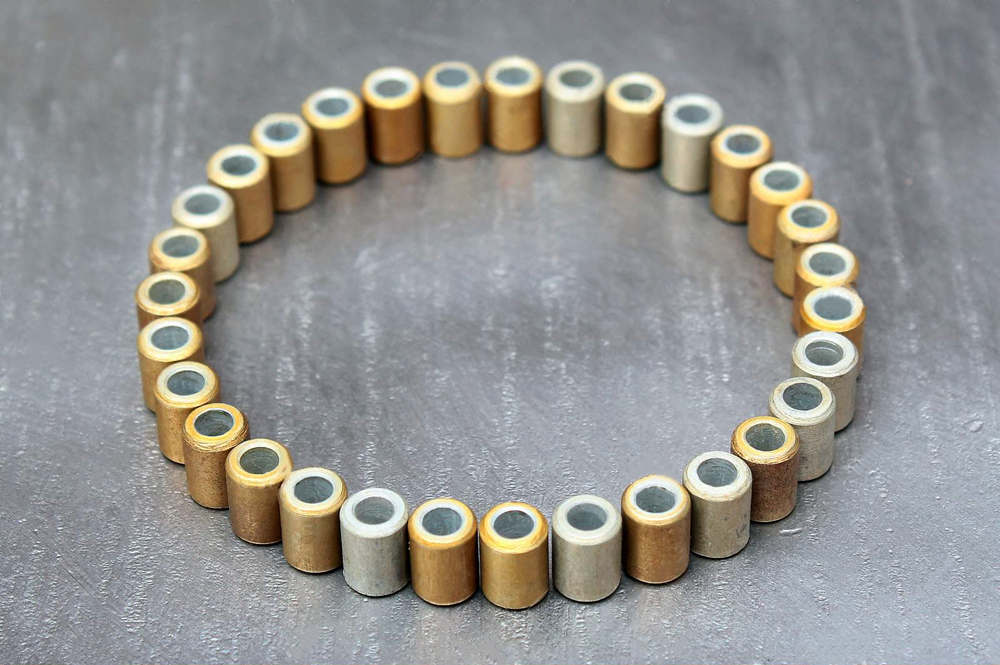
sleeve bearing for cooling fan


Single Ball Bearing

Single Ball Bearing(1 Ball +1 Sleeve Bearing) is an improvement on the traditional sleeve bearing. It adopts the mixed form of sliding friction and rolling friction. In fact, it uses one ball bearing with one sleeve bearing to reduce the cost of double ball bearing.


Its rotor and stator are lubricated with balls and supplied with lubricating oil. It overcomes the shortcomings of short service life and unstable operation of oil bearing, and the cost increase is extremely limited.

The single ball bearing absorbs the advantages of sleeve bearing and double ball bearing, and prolongs the service life of bearing to 40,000 hours. The disadvantage is that the running noise increases after adding balls, but it is still less than that of double ball bearing.

Double Ball Bearing

Double Ball Bearing (2 Ball Bearing) belongs to high-grade bearing. It adopts the form of rolling friction and uses two ball bearings. There are several tiny steel balls in the bearing around the axis.

When the fan blade or shaft axis rotates, the steel ball rotates along with it,so that the weight of the whole fan blade rotor rests on the ball bearing and indirectly supported by the spring. Because they are all spheres, the friction between the bearing surfaces is effectively reduced, and the service life of the fan bearing is effectively prolonged.


Therefore, the heat output of the radiator is reduced, and the service life is prolonged, which is about 50,000-100,000 hours (when the ambient temperature is set below 25°C). The disadvantages are that the process is more complicated, which leads to the increase of manufacturing cost and higher noise at the same speed level.


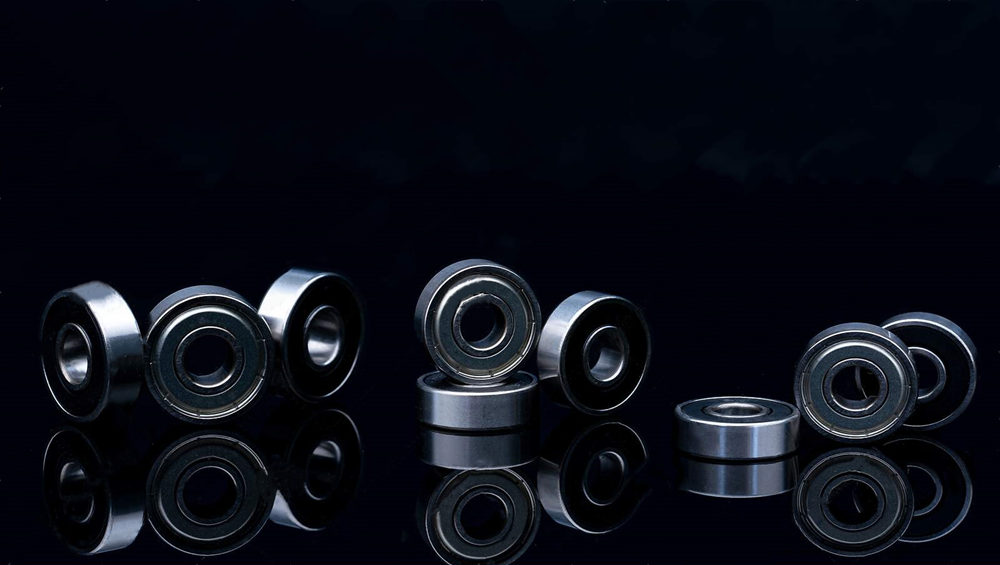
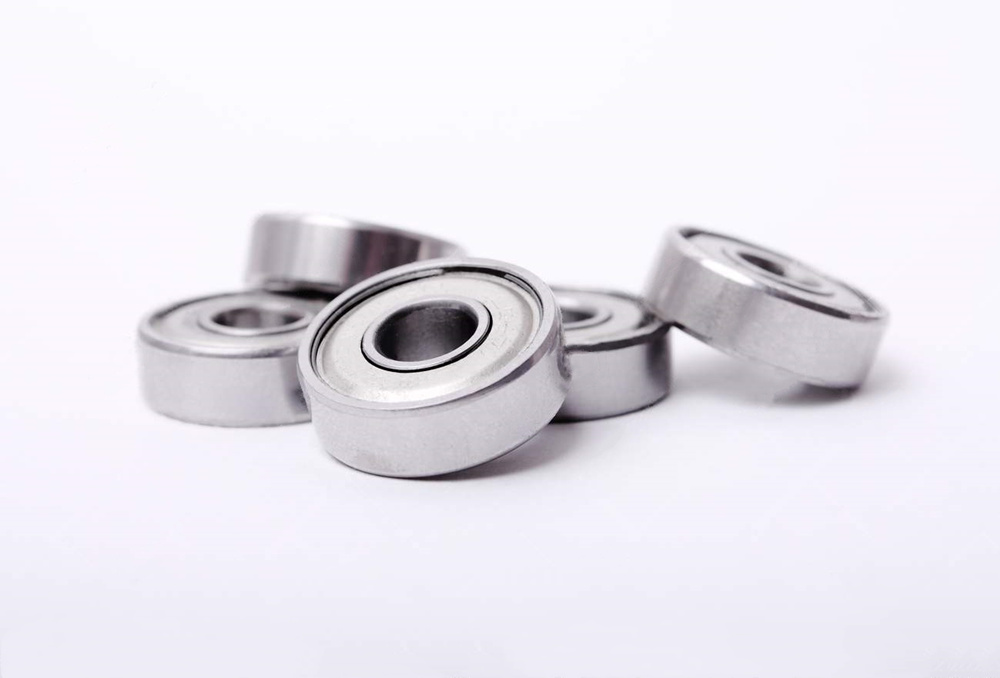
low noise cooling fan ball bearing


The double ball bearing is embedded in the fan, and the rotating part is not in direct contact with the outside world. Compared with sleeve bearing, double ball bearings have batter anti-aging performance, are suitable for fans with higher speed. They have better sealing performance without oil leakage.


In a sealed environment, the working environment of bearings is relatively stable. Therefore, almost all large-diameter fans of 5000 rpm class use double ball bearing.


Cooling fan manufacturers share


Performance of 110V and 220V AC cooling fans in different environments

Our 110V AC cooling fans and 220V AC cooling fans are designed with the effect of air density in mind. For example, 110V AC cooling fans are suitable for a wider range of applications, including low pressure or high altitude environments; 220V AC cooling fans perform well in industrial and commercial environments with large temperature fluctuations.


Select a proper cooling fan based on the environment

Choosing a suitable cooling fan should not only consider the voltage, but also pay attention to the impact of air density on the heat dissipation effect. As a professional 110 v ac cooling fan factory and a reliable 220 v ac cooling fan factory, as a cooling fan manufacturer, we provide professional advice to customers to help them choose the right 110V or 220V AC cooling fan according to their specific needs to ensure that the equipment can operate safely and stably in a variety of environments.

Cooling Fan - Selection of Fan Bearing System


The cooling fans reliability of their bearings is very important, and the type of bearing used by the fan is also very important. So how to choose the cooling fan bearing system?


The best fan bearing system for cooling fans is double ball bearing. The advantages and disadvantages of sleeve bearing, ball bearing in fan bearing system as follows:


Advantages of using sleeve bearing

1. Resistant to impact of external forces, less damage caused during transportation.

2. The price is cheap, compared with ball bearings, the price difference is great.


Disadvantages of sleeve bearing

1. Dust in the air will be sucked into the core of the motor due to the operation of the fan motor, which will mix with the lubricating oil stored around the bearing to make the operation noise, or even get stuck.

2. Bearing inner diameter is easy to wear, short service life.

3. Can not be used in portable products.

4. The clearance between bearing and shaft core is small, and the operation and activation effect of motor is poor.


Advantages of using ball bearing

1. Metal bead operation belongs to point contact, so it is easy to activate the operation.

2. Rolling to generate friction, so the contact surface is small and the coefficient of friction is also small.

3. It can be used in portable products which are often operated in different angles and directions.

4. Compared with sleeve bearing, the service life is longer.

5. Ball bearing system features high efficiency and low heat generation.


Disadvantages of ball bearing

1. Bearing structure is quite fragile, unable to withstand the impact of external forces.

2. When the motor is rotating, the rolling of the metal bead will produce a large noise.

3. The process is more complex and the price is high, so it can not compete with the oil bearing in the cost price.

4. Ball bearings use the elasticity of spring to position them, and it is not easy to assemble them.


Double ball bearing cooling fan


Ball bearings are used for high speed fans and sleeve bearings are used for low speed fans. More advanced than single ball is double ball bearing. Sleeve bearing life is generally 10,000 hours, single ball bearing is 30,000 hours, double ball bearing is more than 50,000 hours.


The ball bearing replaces the sliding friction by rolling friction. The friction coefficient is small and overcomes the disadvantage that the friction coefficient is easily changed. Therefore, the running stability is strong and the service life is relatively long.


So choose the cooling ball bearing system to choose double ball bearings. It has advantages over other bearings in use.


Cooling Fan - Working Principle of AC & DC Fan

Working principle of AC fan:

The difference between AC axial fan and DC axial fan is that the former power supply is AC, the power supply voltage is negatively altered, the fan power supply voltage is fixed, and the circuit control must be rely on circuit control, so that the two sets of coils will work to produce different magnetic fields.


AC cooling fan is fixed due to the power supply frequency, so the magnetic pole variation speed of silicon steel sheet is determined by the power supply frequency. The frequency of the high magnetic field switching speed is faster, theoretical speed is more faster, just like the DC fan is extremely more speed. same. However, the frequency can not be too fast, the frequency is not too fast, which will cause difficulty in starting.

AC & DC axial cooling fan


Working principle of DC fan:


DC cooling fan, the conductor passes through the current, and the magnetic field is generated around. When the conductor is placed in another fixed magnetic field, suction or repulsive force will cause the object to move. Inside the DC fan, there is a magnetic rubber magnet with a magnetic property. Surrounded by silicon steel sheets, the axial part is wound into two sets of coils, and the Hall induction component is used as the synchronous detection device, which controls a set of circuits, which makes the two sets of coils that work around the axis.

Silicon steel sheets produce different magnetic poles, and the magnetic pole produces a remodeling force in the rubber magnet. When the rendering force is greater than the static friction of the fan, the blade naturally turns. Since the Hall induction component provides a synchronous signal, the sector is thus continuously. The piece provides a synchronization signal, and the blade is thus continuously running.


How does air density affect cooling fan performance? -- Cooling fan manufacturer interpretation


The importance of air density for cooling fans

air cooler axial fan


The air density is the key factor affecting the cooling performance of the cooling fan. Under different environmental conditions (such as temperature, altitude and climate), the air density will change, which will affect the heat dissipation effect. As a professional cooling fan manufacturer, our products cover 110V AC cooling fan and 220V AC cooling fan. We are both a professional 110 v ac cooling fan factory and a reliable 220 v ac cooling fan factory , committed to providing high-quality cooling solutions in various air density environments.


Influence of air density on cooling effect of cooling fan


High-density air (cold air) environment: In an environment with higher air density, such as a low temperature environment, the air contains more molecules per unit volume, making the air able to carry more heat, so the heat dissipation effect is better.

Low-density air (hot air) environments: At higher temperatures or at high altitudes, the air is less dense, reducing its heat transfer capacity. In this environment, the efficiency of the cooling fan will be reduced, especially for 220V AC cooling fans, and the performance in low-density air is an important design consideration.

Introduction of some related knowledge about cooling fan noise


How to measure the noise of cooling fan? What are the main factors related to the noise generated by cooling fans? How should we reduce the noise of cooling fans?


1、How to measure the noise of cooling fan?

Noise is the sound level generated by the cooling fan during operation, and its unit is decibel (dB).

Quiet cooling fan, when measuring the noise of the cooling fan, it needs to be carried out in a Anechoic Chamber with noise less than 17dB, one meter away from the fan, and aligned with the air inlet of the fan along the direction of the rotating shaft of the cooling fan.

The spectral characteristics of the noise of the cooling fan are also very important, so it is necessary to record the noise frequency distribution of the cooling fan with a spectrometer. Generally, it is required that the noise of the cooling fan should be small and there should be no abnormal sound.


Anechoic Chamber


2、What are the main factors related to the noise generated by cooling fans?

The noise of high speed exhaust fan is related to friction and air flow. The higher the rotating speed and the larger the air volume of the cooling fan, the greater the noise will be.

In addition, if the fan bearing lacks lubricating oil or has too much dust, it will also cause fan noise, which needs to be maintained and cleaned in time, so as not to damage the hardware equipment due to blocked cooling.


3、How should we reduce the noise of cooling fans?

To solve this problem, we can try to use larger cooling fans. Under the condition of the same air volume, the working noise of the fan with large size at lower speed is smaller than that of the fan with small size at higher speed.

Another factor that we easily overlook is the bearing of the cooling fan.

Brushless motor fan, because the rotating shaft and bearing collide with each other when the cooling fan rotates at high speed, it is also a main source of noise of the cooling fan.